Archive for the ‘Books’ Category
The “Voice” of Moses in Deuteronomy
In his new collection of essays, The Gospel according to Moses: Theological and Ethical Reflections on the Book of Deuteronomy (Cascade, 2012), Dan Block has a helpful chart delineating the “voices” in Deuteronomy, which I’m providing below. The content comes from a previously published article, “Recovering the Voice of Moses: The Genesis of Deuteronomy,” JETS 44 (2001): 385-408. Based on internal and external evidence, Block argues that three particular voices are clear: (1) Yahweh’s voice, (2) Moses’ voice, and (3) the narrator’s voice.
- Yahweh’s Voice in Deuteronomy—31:14b, 16b-21, 23b; 32:49-52; 34:4b
- Moses’ Voice in Deuteronomy
- Moses’ Lone Voice—1:6-4:40; 4:44-26:19; 28:1-69 [Eng 29:1]; 27:11-26; 29:1 [Eng 2]-30:20; 32:1-43, 46b-47; 33:2-29
- Moses’ Accompanied Voice—27:1-8, 9-10
- The Narrator’s Voice in Deuteronomy—1:1-5; 2:10-12, 20-23; 3:9, 11, 13b-14; 4:41-43, 44-5:1a; 10:6-9; 27:1a, 9a, 11; 28:68 [Eng 29:1]; 29:1 [Eng 29:2]; 31:1-2a, 7a, 9-10a, 14a, 14c-16a, 22-23a, 24-25, 30; 32:44-46a, 48; 33:1-2a; 34:5-12
Block holds the traditional view that Moses is the author/speaker (the main “voice”) of the majority of the book of Deuteronomy, and I think his article is convincing on this point and helpful, especially as I read through the biblical book. Block has also published a companion volume prior to this one, How I Love Your Torah, O Lord!: Studies in the Book of Deuteronomy (Cascade, 2011). Both volumes are great to have in my personal library, and I look forward to his forthcoming commentary on Deuteronomy in the NIVAC series, which is slated to be released in August 2012.
Counterfeit Gospels—Trevin Wax
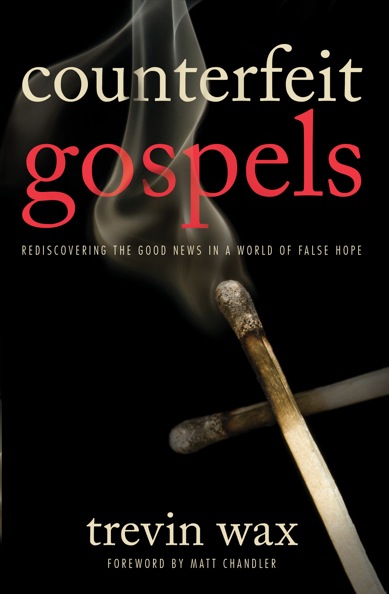 A couple of months ago I put my name into this site, and then I received a copy of this book from the publisher for the purpose of this short review. I was please to see that the book I received was by Trevin Wax, Counterfeit Gospels (Moody, 2011). I’ve always enjoyed Trevin’s blog, and I’ve had the opportunity to speak with him a couple of times. He’s a great guy and I’m thankful for the work he is doing for the church at Lifeway.
I was skeptical about Counterfeit Gospels at first, mainly because so many books on the gospel have been printed recently and I didn’t think that we needed another. But I really enjoyed this one in particular. Trevin’s writing style is engaging and personal. Many of his stories and illustrations I can relate to, which kept me reading. The book is broken up into three parts: (1) Story, (2) Announcement, and (3) Community. These three parts form the backbone of the biblical gospel. There is a story that culminates in Jesus (his life, death, and resurrection), an announcement that all people should repent and believe, and a community that gospel believers should be a part of—the church. Trevin frequently refers to this as a three-legged stool: the gospel story provides the context for the gospel announcement, which then births the gospel community. The best way to do evangelism, Trevin says, is to emphasize all three.
Within each part Trevin highlights two “counterfeits” that subvert the gospel. For part 1 there is the therapeutic and judgmentless gospels, each offering a counterfeit story/announcement/community. In part 2 Trevin mentions the moralistic and quietistic gospel counterfeits, and in part 3 the activist and churchless counterfeits. I won’t explain them here, but Trevin provides a helpful chart on pg. 210. All of the counterfeits are false gospels that ensnare the church. Thus the purpose of the book is to articulate the true gospel and to show how attempts to change it ultimately fall flat.
The implications of the gospel are far-reaching, so the church must get it right. Every generation will need to understand the biblical gospel and apply it to appropriate contexts. Trevin Wax has given us a great little aid for doing that in this generation, and I’m glad I had the opportunity to read Counterfeit Gospels and recommend it to others.
Unbroken—Laura Hillendbrand
 This is a fantastic book about Louie Zamperini, a WWII vet who survived a plane crash, 47 days adrift at sea in a life raft, and then nearly three years of hard labor and torture at the hands of the Japanese. He’s eventually rescued after the atom bomb ends the war. The story takes so many unexpected turns it’s almost unbelievable. And the best part is that after the war Zamperini comes to grips with his own sinfulness and despair and somehow finds his way to a Billy Graham crusade in Los Angeles. There he puts his faith in Christ and is forever changed.
When this book was released I kept avoiding it because I knew I would get sucked in and be distracted from seminary reading. But I’m glad that I finally read it. I would encourage anyone interested in WWII history to pick it up.
New Preaching Commentary by Jim Hamilton
 I first met Jim Hamilton three years ago in 2009 in an attempt to convince him to be the preaching pastor at my church, Kenwood Baptist. He was intrigued and agreed to come preach for two Sundays and pray about it. Which text did he preach on as a candidate for pastor? Revelation 9 for the first and Revelation 10 for the second. Although skeptical at first (I say that with a smile), I was blessed afterward.
When we called him as pastor a month later he preached through the entire book of Revelation in a little over a year. The sermons are outstanding and you can find them on Kenwood’s website here. He has preached through four more books since that time (Titus, Ezra, Nehemiah, Mark, and now Jeremiah), but the sermons on Revelation are favorites of mine.
The sermons are now in manuscript form and part of the Preaching the Word commentary series. Revelation: The Spirit Speaks to the Churches is Jim’s newest book, and I’m thankful for the copy I have in my hands. Jim sets Revelation in a biblical theological context, combining exegetical precision with pastoral sensitivity. I’m grateful for his efforts in this regard. Jim communicates in a way that sticks, so to speak. I never left the pew on Sunday without having grasped both the meaning of the text in context and the need to “do” and apply. Jim is unique in this way. After all, who else do you know who would preach on the Seven Angels and Seven Plagues (Rev 15) on Christmas!
I want to encourage readers to get a copy of this commentary, and you won’t be disappointed.
New Titles from Peter Enns


I noticed today that Peter Enns has two new books that will be available later this year: a commentary on Ecclesiastes (NHC) and another entitled The Evolution of Adam. He gives a description of each in this post, and both will be intriguing to say the least. I think it interesting that he says the following in his description of the Ecclesiastes commentary:
Those of you who know me well will not be surprised that in the theological section I apply a Christotelic hermeneutic. Also, for the truly geekified among you, I do not see Qohelet’s words as corrected by the epilogue but affirmed as wise–though not the final word. I also see Qohelet as a suffering Christ figure. (Yes, you heard me right.)
Having read Enns’ Exodus commentary in its entirety (in the NIVAC series), I can vouch for Enns’ exegetical skill. That commentary is superb, and so I look forward to good things from this one too. Enns is well-versed in the Wisdom writings and the secondary literature. Interested students should pick up his annotated bibliography, Poetry and Wisdom (Baker), which I found really helpful last year during my independent study on Proverbs with Duane Garrett.
On The Evolution of Adam, Enns says it “applies the approach of Inspiration and Incarnation to a specific and pressing issue: in view of evolution, what does it mean to read the Bible well? So think of EOA as I&I part two.” Having also read I&I (and having significant disagreements), this new work will no doubt receive attention from evangelicals, especially given the events surrounding I&I at Westminster Seminary and the ensuing debate that lead to Enns’ departure.
Eisenbrauns Deal of the Day!
Eisenbrauns has Biblia Sacra for its deal of the day. It’s half off for those interested!

Biblia Sacra Utriusque Testamenti
Editio Hebraica et Graeca
The Nestle-Aland 27th edition and BHS small edition bound together
Deutsche Bibelgesellschaft Stuttgart, 1994
93 + 810 pages (Greek) + lvii + 1574 pages (Hebrew), Greek and Hebrew
Cloth
ISBN: 9783438052506
List Price: $139.99
Your Price: $70.00
www.eisenbrauns.com/item/BIBLIASAC
Bookbinding
I sent four Bibles off to Ace Bookbinding recently to have them repaired and rebound. I got them back in the mail yesterday (what a birthday surprise!) and I couldn’t be happier with the results. Three of these I tend to use regularly: a small ESV, a large-print Biblia Hebraica Stuttgartensia, and the NA27/NET diglot. I also picked up a Reader’s Hebrew and Greek Bible recently and hope to use it for reading more lengthy passages. The problem is that the cover and binding were fairly poor quality, so I added it into the mix.
My ESV was particularly miserable. I had silver duct tape around the sides to keep the binding together. Now it has a clean calfskin cover.

With Ace Bookbinding, even though you can choose from many colors, they can also match the color of the original, as in my Greek New Testament:

I never did like the title, “A Reader’s Hebrew and Greek Bible,” so I asked them to leave “Reader’s” off the new cover:


This is probably the Bible that gets most wear and tear, so I’m thankful and excited for the new binding. Since it is a bigger Bible (in terms of thickness), Ace provides the option of adding more ribbon dividers, so I now have four ribbons instead of one.

As you can see, the pages are sown instead of glued for each Bible, so I expect them to last a very long time:
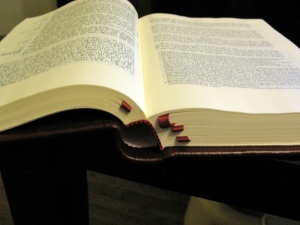

Many thanks to Ace Bookbinding for their good work! If you need a Bible or a big book rebound, I encourage you to check them out. I think they did a fantastic job.


 Josh Philpot

