Archive for the ‘Old Testament’ Category
Where do we find wisdom?
Proverbs 8 is a beautiful passage of scripture, although it’s very difficult to interpret. One of the central questions in that chapter is, “where can we find wisdom?” Wisdom is personified in Proverbs 8 as elsewhere in the book and is presented by the author (Solomon, I believe) as an extremely attractive, beautiful woman—Lady Wisdom. So where does one find such an attractive woman? The chapter gives details about finding her and also about the the places where she can be found:
- She is “on the heights, beside the way” (v. 2a)
- She is “at the crossroads” (v. 2b)
- She is “beside the gates in front of the town” (v. 3a)
- She is “at the entrance” (v. 3b)
- She is “among the paths of righteousness/justice” (v. 20)
- She is “at the beginning of Yhwh’s way” (v. 22)
- When God established the heavens, she was there (v. 27)
- She is “beside him [God], like a master workman” (v. 30a)
- She is “before him [God]” (v. 30b)
- She is always “rejoicing in his inhabited world” (v. 31)
What can we conclude from this list? Two things: 1) “Wisdom”—Lady Wisdom—is with God, and 2) she is amongst us in the world.
These concepts obviously have to do with God’s presence. Wisdom, therefore, is much like the “angel of Yhwh” in the OT. Wisdom is “with” God (indeed, the personified wisdom is God in some sense), but also in the world at the same time. To grasp wisdom, taking hold of her, not forsaking her, loving her, and prizing her highly (Prov 4:5-9), is to partake in the presence of God himself.
The Preface of My Dissertation
On Friday I will graduate for the second time from The Southern Baptist Theological Seminary. The first time was when I completed the MDiv in 2009, and now four years later from the PhD program. I had the opportunity to write a “Preface” for my dissertation, which I had never done before. So in reflecting on this process, I wrote the following:
This project would not have been possible without the guidance of the many people who encouraged me to pursue a seminary degree, and who were faithful to support me through to its completion. This entire dissertation was written from Spring, Texas while serving as Pastor for Worship at Founders Baptist Church. I am deeply thankful to Founders for allowing me to spend this last year writing. The people of Founders have been truly amazing in their display of love for me and my family. I am especially thankful for Pastor Richard Caldwell for his constant care and support, as well as his interest in my topic.
My interest in Exodus 34 and the episode of Moses’ shining face began with a discussion outside of the office of my supervisor, Dr. Duane A. Garrett, who was completing a commentary on Exodus at the time. He suggested that I write a paper on this passage seeing that it was commonly misunderstood, especially in evangelical circles. My later work on Exodus 34 was generally well received, and so Dr. Garrett suggested that I consider it for my dissertation. I am extremely grateful to him for his support and guidance during this process, and for taking me on as one of his doctoral students.
My doctoral studies began while I was serving with Dr. James M. Hamilton Jr. on the pastoral staff at Kenwood Baptist Church in Louisville, Kentucky. Dr. Hamilton has influenced me pastorally and theologically more than any other person. I am grateful to him for his friendship and love for me and my family, not to mention his keen insight on all Old Testament matters and comprehensive biblical knowledge. Out of all the things I miss about Louisville, I miss serving with Dr. Hamilton the most. Thank you for modeling a strong work ethic, humility, sincerity, and biblical preaching.
My wife, Jenn, has been the constancy one needs when completing a large-scale project. Thank you for your endless prayers and encouragement, and your devotion to me when I grew weary from time to time. Thank you for your love, most of all, and for your commitment to being a godly wife and a mother. You bring more joy to me than you will ever know! And, “The heart of her husband trusts in her” (Prov 31:11).
To our kids, Isaiah, Eliana, and Mikaela, thank you for confirming for me each day that “the light of the eyes rejoices the heart” (Prov 15:30). I am looking forward to having many more mornings and evenings together!
Lastly, I am dedicating this dissertation to my parents, Gary and Pam Philpot. Your influence on me as a young man was a significant blessing throughout. And now, as a husband and father, I am beginning to understand just how important Christian parents are in the lives of their children. Thank you for your prayerful encouragement and loving example of a godly marriage. My prayer is that the Lord would “make his face to shine upon you” (Num 6:25) as you persevere in the gospel of grace.
Joshua Matthew Philpot
Spring, Texas
December 2013
Riches, Honor, and Life
In 1 Kings 3:13-14, God offers Solomon riches, honor, and long life, although the latter is conditional upon Solomon’s obedience to God’s law:
I give you also what you have not asked, both riches and honor, so that no other king shall compare with you, all your days. And if you will walk in my ways, keeping my statutes and my commandments, as your father David walked, then I will lengthen your days.
These three benefits are in Lady Wisdom’s hands in Proverbs 3:16 (“Long life is in her right hand; in her left hand are riches and honor.”), and are the “rewards for humility” in Proverbs 22:4 (“The reward for humility and fear of the Yhwh is riches and honor and life.”).
In Christ, the results of a wise life are “riches” in heaven (Matt 6:19-20), “honor” in believing (1 Pet 2:7), and “eternal life” (John 3:36).
Ardel Caneday on Peter Enns and the NT Use of the OT
At the Credo Magazine blog, NT scholar Ardel Caneday completed a series on the NT use of the OT, and particularly with recent arguments from OT scholar Peter Enns. Enns was dismissed from Westminster Theological Seminary a few years back (he may have resigned; I can’t remember) over the hermeneutical position he took in the book, Inspiration and Incarnation. The articles from Candeday are long but worth the time for anyone interested in the topic, especially the last two which deal with Enns in particular:
On the New Testament’s Use of the Old Testament (part 1)
On the New Testament’s Use of the Old Testament (part 2)
Would Paul Have Made a Good Evangelical? (part 3)
Would Paul Have Made a Good Evangelical? (part 4)
While not dismissing the value of some of Enns’ works on the OT (his Exodus commentary in the NIVAC series is excellent, as are some of his contributions to Wisdom Literature studies), his more recent works have only confirmed why WTS dismissed him (rightly, in my opinion) from their faculty.
The “Voice” of Moses in Deuteronomy
In his new collection of essays, The Gospel according to Moses: Theological and Ethical Reflections on the Book of Deuteronomy (Cascade, 2012), Dan Block has a helpful chart delineating the “voices” in Deuteronomy, which I’m providing below. The content comes from a previously published article, “Recovering the Voice of Moses: The Genesis of Deuteronomy,” JETS 44 (2001): 385-408. Based on internal and external evidence, Block argues that three particular voices are clear: (1) Yahweh’s voice, (2) Moses’ voice, and (3) the narrator’s voice.
- Yahweh’s Voice in Deuteronomy—31:14b, 16b-21, 23b; 32:49-52; 34:4b
- Moses’ Voice in Deuteronomy
- Moses’ Lone Voice—1:6-4:40; 4:44-26:19; 28:1-69 [Eng 29:1]; 27:11-26; 29:1 [Eng 2]-30:20; 32:1-43, 46b-47; 33:2-29
- Moses’ Accompanied Voice—27:1-8, 9-10
- The Narrator’s Voice in Deuteronomy—1:1-5; 2:10-12, 20-23; 3:9, 11, 13b-14; 4:41-43, 44-5:1a; 10:6-9; 27:1a, 9a, 11; 28:68 [Eng 29:1]; 29:1 [Eng 29:2]; 31:1-2a, 7a, 9-10a, 14a, 14c-16a, 22-23a, 24-25, 30; 32:44-46a, 48; 33:1-2a; 34:5-12
Block holds the traditional view that Moses is the author/speaker (the main “voice”) of the majority of the book of Deuteronomy, and I think his article is convincing on this point and helpful, especially as I read through the biblical book. Block has also published a companion volume prior to this one, How I Love Your Torah, O Lord!: Studies in the Book of Deuteronomy (Cascade, 2011). Both volumes are great to have in my personal library, and I look forward to his forthcoming commentary on Deuteronomy in the NIVAC series, which is slated to be released in August 2012.
God’s Wisdom in Proverbs—Dan Phillips
 Intro: I read most major works on the book of Proverbs for my doctoral coursework. So I try to make myself aware of new material on Proverbs. Kress Biblical Resources recently released a new book by Dan Phillips entitled, God’s Wisdom in Proverbs. Phillips is a pastor and blogger (see here). I first heard of him via his contributions to the Pyromaniacs blog. His writing is engaging and often humorous. It’s unique in the sense that I almost get the feeling that I’m conversing with him as I read. There is a give-and-take feel that is enjoyable. This new book is no different in style, although it is particularly rich theologically and pastorally, which is a refreshing take on a book that many take to be full or moralistic maxims.
Summary: The main thrust of God’s Wisdom in Proverbs is that the biblical book is not primarily about wisdom in general, but wisdom rooted in the revelation of God’s word; i.e., a wisdom that is defined as the skill for living in the fear of Yahweh. The first two chapters deal with interpretative issues, authorship, and design. Then Phillips spends a great deal defining “the fear of Yahweh” and “wisdom” in both the context of Proverbs and God’s unfolding revelation. These early chapters are focused on the sections of Proverbs that are most familiar: 1:1-7, 2:1-5, and 3:1-12. Then Phillips has three lengthy chapters on big topics in Proverbs like godly relationships, marriage, and child-training. The book ends with four appendices that provide further material—FAQ’s, as it were—on common mistakes and questions that Proverbs addresses, as well as some suggestions for teaching or preaching from the book. As someone who has thought a lot about how best to preach from Proverbs, I found this section particularly helpful.
I was a little confused as I began reading this book because I was expecting something entirely different. The title suggests that the book is a commentary. It is not a commentary. It begins like one (with introductory topics on the front end) and ends like one (with appendices on a few ancillary issues). So my initial comments in the margins of the book are the critical “this-is-not-how-to-write-a-commentary” type. But as I continued to read I was corrected, and then I was more and more refreshed by Phillips’ writing, particularly in the chapters on marriage and child rearing. Indeed, I think Phillips has written the best thematic study on training children in Proverbs that I have read. No other commentary or book goes into the depth that he does on this topic, which includes a helpful biblical theological perspective. I was greatly encouraged by it and I hope to read that section again with my wife.
A little criticism: I have a few points of critical interaction. First, if someone is interested in delving into the issues surrounding Solomonic authorship I would suggest a few other resources. This is not to say that Phillips’ arguments are invalid, only that he doesn’t deal with all the historical and grammatical evidence against Solomonic authorship (I obviously agree that Solomon wrote the majority of the book). For instance, there is no mention of the Wisdom of Amenemope and how it relates to Proverbs 22:17-24:22, which is a huge issue in the authorship of Proverbs debate. One might think that this discussion has no place in a book like the one Phillips is writing, but since he devotes 11 pages at the beginning of the book to the issue of authorship in addition to an entire appendix (20 more pages), I would say that a big issue like this is worth treating (or at least referencing). He could easily point to Kenneth Kitchen’s article, “Proverbs and Wisdom Books in the Ancient Near East” (TB, 1977) or even Waltke’s section in his commentary to refute the critical view that says the Proverbs were adapted from Egyptian wisdom literature (which is patently false).
Second, the bibliography is a little dated, too, and Phillips missed a few excellent works like Steinmann’s commentary in the Concordia series (2009). That commentary has its own issues, but overall it’s the newest exhaustive commentary on Proverbs from a conservative perspective. Additionally I would have liked to see journal articles in the bibliography, of which there are very few. On the sources that Phillips does include in the bibliography, he adds a few comments so that readers know ahead of time what he thinks about the source. I’m studying with Duane Garrett who wrote a commentary on Proverbs (albeit a short one). On this book Phillips writes, “I would say that 90% of the time I go to Garrett for help with a verse, I come away disappointed.” I would be happy to expound on that point if Phillips ever desires to hear it. 🙂
Third, sometimes the organization of the various chapters is confusing. I would expect that in a book on Proverbs, for instance, the author to treat the material of a specific topic (such as marriage) within the book of Proverbs first before going to other books of the Bible to find material on the same topic. Phillips does this the other way around. In the end the reader arrives at the same point, just only by getting there via different avenues.
Last, Phillips goes a little overboard on word studies. I grant that lexical analysis is needed, especially in Proverbs as every commentator is prone to point out. But I think that Phillips could communicate his points clearly without going into the definitions of so many words. The definitions help, 0f course, but I was more interested in how the words are used in various contexts.
Conclusion: Dan Phillips and I are a like in a few ways. We’re both pastors. We’re both new to the Houston area. He’s bald and I’m balding. And we both love the book of Proverbs. On this last point I’m grateful that he has given us a fresh look at Proverbs with a pastoral perspective. He is a clever and witty writer, and the his points are clear. Although I have a few foibles with the book, it’s infinitely better than Longman’s How to Read Proverbs, and deserves a place on the shelf. I’m glad to have read it and I would certainly recommend it to others. It’s not a seminary-type book and I wouldn’t use it in the classroom at the M.Div. level, but I would in an undergrad setting.
Numbers 16 in Psalm 55
Tonight I taught on Psalm 55 at Kenwood Baptist Church. The psalm is about David’s inner turmoil and anguish due to the betrayal of a close friend(s). Verse 15 stands apart in that David calls for harsh judgment on these former companions—”Let death steal over them; let them go down to Sheol alive.”
“Sheol” is found frequently in the Bible, but as I was studying the psalm I realized that the latter phrase of v. 15—”let them go down to Sheol alive”—is unique in that it appears only twice in the OT: here in Psalm 55:15 and also in Numbers 16:30, 33, the passage about the Korahite rebellion. In that passage, Dathan and Abiram are destroyed as a consequence of their rebellion against God and their rejection of Moses’ leadership. To demonstrate that God had judged their insolence and that their death was not the ordinary lot of human beings, the ground opened up and Dathan, Abiram, and their families “went down alive to Sheol.” The Hebrew construction in Numbers 16:30, 33 is essentially identical to the one in Psalm 55:15:
Num 16:30 — וְיָרְדוּ חַיִּים שְׁאֹלָה
Ps 55:15 — יֵרְדוּ שְׁאוֹל חַיִּים
So perhaps David had the Korahite rebellion in mind when he called for judgment on his enemies/former-friends. What he wants is probably not the same mode of judgment (i.e. the ground opening up), but the same kind of judgment—abrupt and unexpected.
A few thoughts on Exodus 34:29
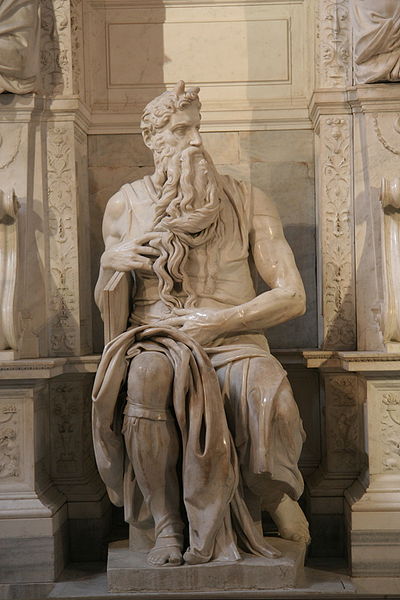
- Moses’ second descent from Sinai is much different from the first. This time he has two new tablets and a changed complexion: the skin of his face is “shining” (from Heb. qrn) because he had been talking with God. The use of qrn here is odd since it usually means “horns,” not “to shine,” as depicted in Michelangelo’s statue of Moses in the church of San Pietro, Rome. Michelangelo based his depiction of Moses on the translation of qrn in the Vulgate (“he knew not that his face was horned“).
- Scholars differ on the interpretation of qrn in Exod 34: Jirku (“horns”), Propp (“disfigurement,” or blistered skin), Sasson (“horns”), Stuart (“rays”), Sanders (“light”), Cassuto (“rays of light”), Childs (“rays of light”), Enns (“afterglow”), etc. The LXX has, “the skin of [Moses’] face had become glorified.” Paul follows the LXX: “The Israelites could not look steadily at the face of Moses because of its glory” (2 Cor 3:7).
- While it is true that qrn normally means “horns” (see HALOT, vol 3, 1144), in this case we must consider alternatives. The verbal form here in Exod 34 literally means “to show horns,” not “to shine.” But consider this analogy: my kids and I drew a picture of the sun today with yellow crayons. Like most kids do (and adults too), we drew spikes, or “horns,” around the sun to show that it emanates light and that it’s really hot. Perhaps what we have in Exod 34 is similar. The skin of Moses’ face shines just like the sun shines. Instead of saying that Moses’ face “was shining” (using the normal language of illumination) the author of Moses depicts Moses’ face much like we would draw the sun: he had horns of light (a similar analogy would be the head of the Statue of Liberty); that is, rays that reflect the very brightness of Yahweh’s own presence. As Cassuto writes, “Something of the divine glory remained with [Moses], and on an infinitesimal scale he also had rays at his side—enveloping his countenance.”
- Habbakuk 3:4 substantiates the interpretation of qrn as rays of light: “[God’s] brightness was like the light; beams of light (qrn) come from his hand; and there he veiled his power.”
New Titles from Peter Enns


I noticed today that Peter Enns has two new books that will be available later this year: a commentary on Ecclesiastes (NHC) and another entitled The Evolution of Adam. He gives a description of each in this post, and both will be intriguing to say the least. I think it interesting that he says the following in his description of the Ecclesiastes commentary:
Those of you who know me well will not be surprised that in the theological section I apply a Christotelic hermeneutic. Also, for the truly geekified among you, I do not see Qohelet’s words as corrected by the epilogue but affirmed as wise–though not the final word. I also see Qohelet as a suffering Christ figure. (Yes, you heard me right.)
Having read Enns’ Exodus commentary in its entirety (in the NIVAC series), I can vouch for Enns’ exegetical skill. That commentary is superb, and so I look forward to good things from this one too. Enns is well-versed in the Wisdom writings and the secondary literature. Interested students should pick up his annotated bibliography, Poetry and Wisdom (Baker), which I found really helpful last year during my independent study on Proverbs with Duane Garrett.
On The Evolution of Adam, Enns says it “applies the approach of Inspiration and Incarnation to a specific and pressing issue: in view of evolution, what does it mean to read the Bible well? So think of EOA as I&I part two.” Having also read I&I (and having significant disagreements), this new work will no doubt receive attention from evangelicals, especially given the events surrounding I&I at Westminster Seminary and the ensuing debate that lead to Enns’ departure.
Old Testament Readings, Anonymous Elders, and Jim Hamilton

At Kenwood we have three scripture readings during our main worship service: a Call to Worship, an Old Testament reading and a New Testament reading. This past Sunday (6/27) we had a hiccup in the service. One of our elders (who will remain anonymous) didn’t realize that he was scheduled for the Old Testament reading. So, when we finished singing “A Mighty Fortress,” and I noticed that this anonymous elder was not walking to pulpit, I began to get a little nervous. But you must understand why I’m nervous at this point: I’m the one responsible for the worship service. If someone is not walking to the pulpit it’s really my fault! So I scramble through hymnals and papers around the piano looking for a Bible, somehow hopeful that I can get to the pulpit and do the reading myself without making it look like I’m unorganized (pet peeve, by the way). I look over at Jim Hamilton seated in the second row, and he’s looking conspicuously around the room for that same anonymous elder who should be at the pulpit reading the Bible by now. He strikes back an inquisitive but partly accusing look in my direction, as if to say, “Haven’t you organized the worship service?” I send back a shrugged shoulder, hoping that he gets the message that the anonymous elder is supposed to be reading. Jim gets my drift, and true to his character (he’s great at spontaneity), he marches quickly up to the pulpit, ready for the task. And this was the result:
We have all been in worship services where our concentration is broken by some distraction. It’s either a high screeching microphone, a baby crying during a prayer, or an anonymous elder forgetting that he’s scheduled to read and pray during the service. We know this well and its amusing to some degree. But each week I try to organize a worship service that might limit our distractions and instead cause all of our efforts to focus on the greatness of God in Christ. Indeed, the whole elder team labors to do this, not simply because we think it’s the right “mood” for worship, but because we want to worship God rightly; that is, in a way that would bring him the most glory. Limiting distractions, I think, is helpful to meeting this goal.
So Jim marched to the pulpit without having read Isaiah 44:24-45:7 and without having prepared a prayer. But afterward, instead of being distracted and instead of feeling some disconnect, Jim helped draw our attention to the greatness of God by reading the Bible with emotion, vigor, sincerity and enthusiasm. And I think his response helped everyone in the congregation, not least myself. In the end, our minds and hearts were once more focused on magnificence of God, and on the awesome privilege we have of worshiping him freely.
I think that Jim should consider a Bible audio book, no?

 Josh Philpot