Pray for Dr. Peter Gentry
 Dr. Gentry recently found out that he has prostate cancer and will need surgery in December. Please pray for him and his family during this difficult time.
Dr. Gentry is Professor of Old Testament Interpretation at Southern Seminary.
Daniel (WBC) – John Goldingay
 I recently finished reading this commentary for my PhD seminar on the prophetic literature. The commentary is technical in the sense that the reader should know biblical Hebrew (and maybe Aramaic) while reading it, but he/she can still engage the work without it as well. The Word Biblical Commentary series breaks up each section (or, chapter) into four parts: Form, Setting, Comments, Explanation. One strength of Goldingay’s commentary lies in the “explanation” section, even though it is somewhat redundant in following the “comments.” There, he thinks through the text theologically and expounds on the material in light of God’s unfolding revelation. The problem is that this is Goldingay’s only strength. Sure, one might gain insights from Goldingay on Daniel’s language, how other non-canonical writers were influenced by Daniel, or even Daniel’s use of the OT, but observations like these are few and far between. Goldingay, rather, thinks that chapters 1-6 are allegorical “historiography” (and thus not actual history), that Daniel was not an historical person, and that the book should be dated during the Maccabean era (c. 168 BC) instead of during the time of the Israelite exile (605-538 BC, as the book itself attests). This dating leads Goldingay to interpret Daniel through the lens of secondary Jewish literature rather than in the context of the Bible, which I believe to be a serious flaw. Furthermore, the meaning of the text is lost in oodles of material on the book’s form, some of which is helpful, to be sure, but liberal to say the least.
In the end, I wouldn’t recommend this commentary for pastors since it lacks that sort of quality. Perhaps students of the OT or of intertestamental literature may benefit, but the commentary is lacking theologically, and Goldingay particularly avoids interaction with conservative approaches. It’s also dated (1989). I haven’t read Steinmann or Lucas yet, but at this point I’m still partial to Baldwin, which is also dated and very short.
Was Adam for real life?
As an evangelical Old Testament student I see Tremper Longman’s name pretty frequently. I begrudgingly read his Introduction to the Old Testament as a junior in college but enjoyed it in the end. I also found his commentary on Proverbs somewhat helpful (though not in the Waltke sense).
However, I’m often at odds sometimes with much of what Longman says or writes. For instance, I remember Dr. Gentry dismantling Longman’s thesis in the NICOT series that Ecclesiastes is equivalent to fictionalized biography (i.e. Frame Narrative theory – see Duane Garrett’s refutation as well in his own commentary, 260-65), which I found to be a serious flap on Longman’s part. I also recently came across this interesting little clip of Longman commenting on the historical Adam, which just adds to my disparity:
For Longman, then, Adam’s historicity isn’t really the main point, and shouldn’t really affect our exegesis or theology. But that’s the question: Does Adam have to be an historical figure for the Bible to make sense, like Longman says? And, what are the implications for sin and headship if Adam is not? Biblical theology? Further, what would John Walton say (for those of you who have read his new book)?
How to write a lot!
Wow! I haven’t posted anything in…how many weeks? 11 it is! I’ve been pouring over a good bit of material in 1 Peter and Daniel, which took over my summer and now consumes most of my time during the week. However, I’ve written a number of posts that are saved and waiting to be edited. Perhaps they will appear this semester (oh, the suspense…).
But until 9/17, the day I present my exegesis of 1 Peter 2:4-10 in my first PhD seminar, I will probably (well, definitely) not post anything. After that presentation I’ll get back to it. In the meantime, I commend this short post to you by Charles Halton on how to make writing part of your daily scholarly life (Jim Hamilton is excellent at doing this). Halton also links to an interview with John Goldingay that I found interesting. I’m currently reading through Goldingay’s commentary on Daniel (WBC), which I hope to write a review for this semester. In my opinion, Goldingay is excellent on theology but totally unconvincing on historical issues surrounding Daniel. Enjoy the Halton post!
Interview for the Towers Newspaper
I was interviewed this week by Garrett Wishall for the seminary newspaper about SBTS students being messengers for the SBC. You can read the article here.
I must confess that I am somewhat disenchanted by demoninational politics, which may or may not be apparent in the article. At the risk of sounding cynical I will refrain from elaborating on that point. What I hope to convey is that I love the church and think that the work of the IMB and NAMB (entities of the SBC) are absolutely necessary and needed (not to mention fruitful). Therefore, I gladly support the SBC and will continue to serve in the denomination as long as the Lord allows.
The Miracles of the Exodus – Colin Humphreys
 I’ve been teaching through the book of Exodus at our Wednesday night Bible study at Kenwood. I picked up this book recently, mostly out of curiosity, to get a scientists take on the miraculous stories in the biblical account.
Summary: The subtitle of the book is, “A Scientists Discovery of the Extraordinary Natural Causes of the Biblical Stories,” and the substance is exactly that. The books author, Colin Humphreys, is a Cambridge University physicists. Although he specializes in “materials science” his hobby is archeology. With that as his motivation he set out to explain God’s amazing victory in bringing the people of Israel out of Egypt using the scientific method. Humphreys not only examines the plagues, the natural phenomenon of the Red Sea crossing, and the location of Mt. Sinai, but also the date of the exodus, the crossing of the Jordan river (Josh. 3), and the location of the lost city of Etham (Ex. 13:20). Using modern science Humphreys concludes that all the events in the book of Exodus are explainable according to natural forces particular to the ancient Near East setting.
What I liked: First, I liked that Humphreys intent is to show that the biblical account is true. Nowhere in the book does Humphreys write that the exodus was false or the result of ancient myth, and for this he is to be commended. Second, Humphreys explanation of the locations of the Red Sea (in the Gulf of Aqaba) and Mt. Sinai (in Midian and not in the Sinai peninsula) is very convincing. I first heard this explanation in an exegesis course on Exodus I took during my M.Div., and after examining other resources I think that of Humphreys is more compelling and fits better with the biblical data. Lastly, the book is very easy to read and accessible for anyone at any level.
What I didn’t like: Where I mainly disagree with Humphreys is in his qualifying presupposition to explaining all the miracles of the Exodus; that is, that natural forces explain everything rather than supernatural ones. In Humphreys’ view, science is able to explain everything, and thus the miracles are only supernatural from Israel’s own perspective. Therefore, what happens in Exodus are miracles of timing. To give one example, the pillar of cloud by day and fire by night – the presence of God leading the Israelites out of Egypt – is explainable as a volcano that erupted at the just the right time. This volcano just happens to be Mt. Sinai, which can be seen from 300 miles away in Egypt. The Israelites follow this cloud each day and night and are thus led by it, according to Humphreys. I think this view demotes the aspect of God’s intervening on the Israelites behalf (which God intended to do from the beginning), and also leaves for a high probability of chance. The same can be said about Humphreys’ take on the plagues, which I think can be disputed on the basis of his own analysis – timing.
Final Analysis: Humphreys has written a good book that was enjoyable to read. It is simple but not overly simplistic. I appreciated his desire to show the truthfulness of the Bible, especially with respect to the factual evidence of Scripture that is so easily disregarded. However, Humphreys demotes the aspect of God’s supernatural intervening on Israel’s behalf, and shows more faith in science than in the biblical record. Therefore, while I would highly recommend the sections on the Red Sea crossing and the location of Mt. Sinai (and other equally commendable chapters), I cannot recommend the sections on the plagues or the pillar of cloud and fire.
Reflections on Seminary part 5
There are 10 things I want to recommend and conclude with. I’ll try to be candid:
- Success in seminary and growth as a future pastor is directly related to your involvement in the local church during seminary. I can’t stress this enough. It is and will always be a blessing for many students to attend large churches with awesome preachers. But the average student (not every student) attends this type of church each Sunday with little or no involvement, even though their intention is to be a pastor. My suggestion is to get out, go to one of the many dying and struggling churches in your area, and just volunteer to do anything to serve that church. I’ve learned more about being a pastor from Mike Thompson’s example, a servant-leader at Kenwood, than anyone else. Though not a deacon or elder, he just serves people with the love of Christ, which flows out of his relationship with God and sincere desire to see the church grow. Pastors are forged in environments like this, watching and emulating the unsung heroes around them, and they will inevitably become better pastors in gaining solid, shepherd-like experience by serving and loving the brothers in local church settings.
- Seminary life is difficult and ever-changing, so be prepared for anything. For example, since I began seminary in August of 2005 I got married, became a diabetic, acted in a musical, moved from Virginia to Kentucky with no job, went through the agonizing process of finding steady income, was hired at Kenwood as Pastor of Worship, hiked through the Grand Canyon, became an uncle to two nieces and one nephew, sustained the impact of two pastors leaving Kenwood, preached and taught consistently for one year while taking classes, was rejected as senior pastor of Kenwood by a small margin (though not rejected as Pastor of Worship), found out that I had Celiac disease, was accepted at SBTS into the PhD program for OT studies, and graduated in May of 2009. Nuts! Take some time, then, to pray with your wife or loved ones about the trials and temptations you might face during seminary. If possible, encourage your home church to pray for you consistently during this time as well.
- On the flip side, seminary life is rewarding and life-changing. For instance, I learned a ton, had the privilege of preaching and teaching the Gospel at Kenwood, had the honor of sitting in class under some of the greatest evangelical scholars of our time, and was able to pay for tuition and books debt free. Through all of this I grew steadily as a Christian and my love for the Gospel and for the church is much greater than when I first arrived.
- Take as many Bible classes as possible, and intersperse practical ministry classes within them each semester. What I mean is to take Hebrew, Greek, Theology and Exegesis courses every semester while taking maybe one class like “Ministry of Leadership” or “Preaching” along side of them. This way you will be able to directly see the correlation between theology and the ministry of the local church. Also, if you have the time, sit in or audit a number of classes. As mentioned in a previous post, I audited something like 27 credit hours, which means that I got all the lectures and notes for classes and didn’t have to do the work. For me this was a engaging and fruitful academic experience. So do your best to make the most out of your time in seminary. Learn as much as you can.
- Take a break from reading theology to read great works of literature. Jenn and I even began reading novels together in the evening, like Jane Eyre, Pride and Prejudice, and A Tale of Two Cities, and we loved it! On top of these I read a lot of Dostoevsky (Crime and Punishment, The Double, The Gambler, Notes from Underground) and David McCullough (1776, John Adams, The Johnstown Flood, and currently reading Truman), both of whom are excellent and fun to read.
- Begin the languages early and never stop reading the Bible or you will get behind, which means that you will probably never catch up.
- Learn from the great ones. My favorite professors in seminary were Drs. Gentry, Garrett, Wellum, Pennington, and Fowler (from LU). Take Gentry for OT I-II and at least one exegesis class, Garrett for OT exegesis as well, Wellum for the Person of Christ and the Work of Christ, Pennington for NT I and Elementary Greek and Syntax, Fowler for anything at LU (he’s their hidden secret). These guys are Southern Seminary’s Augustine, Athanasius, and Calvin. While I learned more about pastoring/shepherding a congregation from Mike Thompon than any other person, I learned more about preaching from these classes and prof’s than any other in seminary, even though other classes were fun and helpful.
- Don’t forget where you came from. My family has continued to be so encouraging and loving during my time here. Both the Philpot’s and the McCarron’s have supported Jenn and I in our move to Louisville and work in the church, and are consistently helpful in all matters of relationships and spiritual health. Our gratitude to them extends beyond what we can say or write. “We give thanks to God always for you, mentioning you constantly in our prayers, remembering before our God and Father your work of faith and labor of love and steadfastness of hope in our Lord Jesus Christ” (1 Thess. 1:2-3).
- Don’t become reclusive. Make some friends and be social! We are blessed with many friends that are loving and encouraging. Noah and Brandy Lee have been so comforting and supportive during the trials at Kenwood; Randall and Bethany Breland as well. By God’s grace both families have joined Kenwood and serve so tirelessly for the work of the ministry. I have great admiration and respect for Dave Schrock, whom I met here at Southern. I want to be like him. Scott Windham has been a great friend from LU to remain in contact with, and he has always had an open ear. Scott and Angela Van Neste are true saints in the faith, who continue to pray and minister to Jenn and I through phone calls and visits. Although he has since left Kenwood for another ministry position, Michael Naaktgeboren is of the “best” kinds of friends, and over the last year or so I looked forward to our weekly meetings at BW3’s almost as much as Sunday! I’m greatly indebted to the friendship of Justin Petrochko, one of the few people that I enjoy talking with on the phone for long hours. He understands me well and has offered supportive and corrective counsel throughout seminary. He, like all of the friends here, are true brothers and sisters in Christ. We’re thankful for everyone, and pray that the Lord will continue to bless our friendship with a life-long quality.
- My final recommendation is simple – Love your wife. Honor her. Cherish her. Talk with her. Serve with her. Do not leave her out of the picture of your life at seminary. There is no way that I can possibly express my indebtedness, gratitude and love for my beautiful Jenn. She has been patient, enduring, hopeful, assuring, encouraging, committed, and loving, and I can’t thank her enough. We are such a bedraggled pair, cut and bruised by our own circumstances and ourselves, yet like Israel on the plains of Moab, God has so much in store for us, and as we approach year four of marriage, I can do nothing better than continue to say that I love her. I love her. I love her. Perhaps poetry might get the point across. In the words of greatest ancient poet, “You have captivated my heart, my sister, my bride; you have captivated my heart with one glance of your eyes” (Song of Songs 4:9). And you continue to captivate my heart.
Reflections on Seminary part 4
For anyone who is interested in my reflections please bear with me because this one is rather long. I need to learn to be succinct.
My final year in seminary was clearly the most significant and strenuous for me as a student and pastor. The summer of 2008 began with the departure of the other associate pastor at Kenwood, Jon Pirtle. Whereas Jon originally expressed interest in becoming the preaching pastor at Kenwood, he decided to leave for his home state of Georgia and begin teaching high school instead. This left me as the only elder and pastor, a difficult task even for a small congregation. It was at this point that our Pastor Search Committee decided to bring me before the congregation to be called as the senior pastor. Although the PSC was not unanimous in their decision it went forward nonetheless. Without going into great detail let me just say that the church did not vote to call me as their senior pastor (that reflection will be for another day), which brought us once again back to the drawing board. Since the PSC was somewhat divided on how to move forward, they all decided that it would be best to absolve that committee and have the church elect a new one, which we did with little resistance. Since I was the only elder and pastor in the church I continued to serve on this new committee as well. In the meantime, knowing that I needed to graduate within the year and therefore take close to 36 credits hours (12 classes), rather than continue to preach on Sunday mornings I asked two friends to fill the responsibilities: Jarvis Williams and Dave Schrock, both of whom Kenwood owes a great deal of gratitude and appreciation. They both served us greatly during this time of transition.
The decision to apply for a PhD came that summer with much prayer and conversation with my wife. Although I never intended on being a perennial student when I entered college in August of 2000, I loved the work and felt that the Lord had blessed me with the desire and abilities to continue to pursue education. Furthermore, as I mentioned in a previous post, as a pastor I’m deeply convicted by the fact that the American church is largely ignorant of the Old Testament. With that in mind I felt that pursuing a PhD would help me become a better pastor and teacher of the Bible. Before applying, however, I felt that I should seek the advice of professors who had me in class and knew my work ethic and ability. So I went to Drs. Gentry and Garrett for counsel. They both encouraged me to pursue doctoral studies and even offered to write letters of recommendation, which I obviously took them up on.
The fall semester proved fruitful but hectic. I took four courses, all while leading worship on Sunday mornings and teaching Sunday and Wednesday evenings at Kenwood. I had little free time, but as I’ve said before, I love the work. In the winter term I took three more classes, even though I only needed two – a course in December right before Christmas and then two courses back-to-back in January. At this point let me offer another recommendation: NEVER take three winter or summer term classes unless you have the time and know what you’re in for. I basically had the time but did not anticipate the amount of work involved, something like 10 books, 10 papers, 5 tests, 6 quizzes, and 120 hours of class time – all within 1 month. More than anything the experience was just exhausting. Avoid this at all costs.
Following my final exam in my final winter-term course (Exegesis of Mark with Dr. Mark Stein) I had about one month to prepare for my PhD exam and interview, which was all part of the application process. This was equally strenuous since the spring semester had also begun. In order to get both of these things done I decided to divide up my day into segments. I would work on studying for the PhD essays from 5:30 – 8:30 AM, go to class for the day from 9:00-3:00, and work on Kenwood Bible studies and worship in the evenings. Since some people might not know, or maybe want to know, what the PhD application process is like I will recall it here. For my part, the testing and interview took place sometime at the end of February. I woke up that morning with a 101° temperature and struggled throughout the day with coughing, snot, and nausea. However the Lord was gracious and I made it through. The test itself was interesting. Since I was applying for Old Testament studies I was required to translate a passage in Hebrew and also answer a number of questions regarding morphology (how words are put together) and syntax (sentence structure and form). Although some of the questions were ambiguous I felt that this part was relatively easy (I just mean that most 2nd year Hebrew students could complete it without any real difficulties). I then had to write an essay on any one of three topics given in Old Testament scholarship. I won’t list them here because I’m unsure of whether they will be used again in the future. This part was somewhat difficult since it was timed, but I was still able to shell out a decent amount of pages in the time allotted. The last part of the test consisted of a general essay in argumentation that was not related to my field of study. I actually found this section quite fun but a little redundant since an identical type of essay was required on the GRE, which everyone had to take anyway. Once the testing was completed I was given an appointment time to meet with the faculty in my department for an interview. This was clearly the most relaxing of the whole process since I’m generally comfortable in conversational settings, and especially with those who were in the interview. Both interviewers knew me personally and set me at ease right away. The only problem was that after the interview was over I was told that I wouldn’t know if I was accepted until April, a full month-and-a-half away! I was notified by letter in early April and promptly accepted my admittance.
Things at Kenwood progressed nicely. At the beginning of this year we were told by one of our chosen candidates that they were declining our offer. This was particularly depressing for me, even though I and everyone else knew that God’s purposes and will is so much greater than our own. I was left with two options: either merge with a large church in Louisville or get in contact with another potential pastoral candidate. I spoke with the PSC about this and they all agreed on the latter. After I heard that Jim Hamilton was seeking a pastorate I contacted him immediately. We met, drove to the church building so he could see the place, spoke about the area and our current members, and decided to pray. I also brought this option before our PSC, who were all intrigued by Jim. We decided to bring him to Kenwood to preach a couple of times, and even though he preached from the tempestuous book of Revelation everyone agreed that he would be an awesome choice. After a PSC interview and congregational interview, Pastor Jim was voted in unanimously on March 29th. It has been a great blessing to serve with him these few months together. By God’s grace I’m growing as a pastor under his leadership.
Graduation took place on May 15th, and after 94 credit hours (and about 27 hours of audits) I finally completed my M.Div. In the next post I will offer some final reflections and recommendations on seminary at Southern.
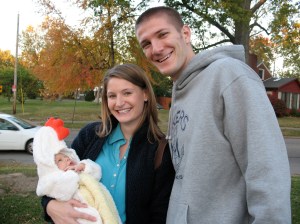
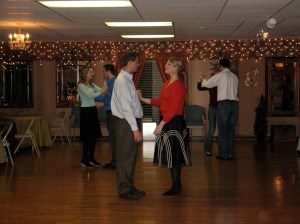
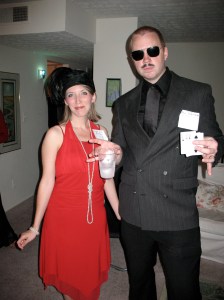
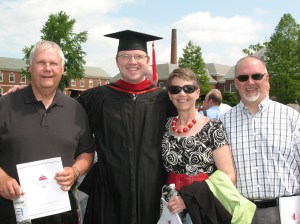
Some pictures from my final year – my in-laws, the Schrock’s, my adorable nieces and nephew, dancing class with our friends, Asa and I making delicious pizza cupcakes (right?), murder mystery night at the Breland’s, and graduation with my family:





Reflections on Seminary part 3
Year three marked one of the more satisfying years academically. After going through a year of Hebrew language study I took my first exegesis class with Dr. Peter Gentry. His influence on my understanding of the Old Testament and my love of the biblical languages far outweighs any other. It was during this class (Exegesis of Isaiah) that I made conscious decision to study the OT to a greater degree, with the hope of resurrecting the OT in preaching and teaching in the church. It has been my observation that most church members, young and old, limit their own understanding of the OT to the Psalms and Proverbs, with a splattering of the great stories of Abraham, Moses, and David (just take a look at many of our Bibles: the NT with Psalms and Proverbs). Rarely does one find a pastor preaching through a book of the OT on Sunday mornings. Additionally, the influence of John MacArthur (whom I love and admire) has somehow convinced many pastors in reformed circles that the church is only to be taught from the NT, and that the OT is limited to illustrative purposes. This was, and is, not satisfying to me. As I understand the task, pastors are to preach the whole counsel of God. The church cannot and must not limit themselves to being practical Marcionites. God has made himself known in his Word, and for all our battling to preserve the authority and inspiration of the Bible, we must act and preach like the whole of it, and not individual parts, is worth the battle. Pastors are never called to preach only the New Covenant (as some might say). Pastors are called to preach the Word.
This leads me to further recommendations. First, do not wait until your final year of seminary to begin Hebrew and Greek. Most seminarians start off with Greek but avoid Hebrew like a plague. In fact, there is a common notion among seminarians that it is unwise to take Hebrew and Greek in the same semester. While there are certain factors that may prohibit this (e.g. full-time job), it is not insurmountable. The earlier you can take the biblical languages the better. Then, as you progress, you can continue to take exegesis courses to improve your skills, and by the end of seminary you should have a good grasp on both languages. Second, study in small spurts and not big chunks. For instance, if it’s Monday and you have a Hebrew vocabulary test on Thursday, don’t wait until Wednesday to begin and don’t work on all 50 vocab words at a time. Rather, divide the words into groups of 10 and put them in your pocket. As you walk to class, sit at lunch, wait for an appointment, etc., get the cards out and go through them a few times. Our brain is more inclined to remember these things if they come in doses, and not all at once. Most of us, including myself, can’t remember everything at first glance. Therefore, help yourself out by studying throughout a day instead of all at once. Third, don’t be content to spend all of your time working on vocabulary and syntax only to lose everything you’ve worked on in a year or so. Continue to work on these things periodically. It will be well worth your effort.
Back to my third year: things changed dramatically for me at Kenwood during this time as well. In December of 2007 our preaching pastor left the church to take a professorship in a different state. The following week our other associate pastor, whom everyone assumed would take the preaching role, was called to military duty, also out of state. This left me for the care of the church. I began preaching every Sunday morning and teaching every Sunday and Wednesday evenings. While the responsibilities were difficult to maintain as a full-time student, and while there were certainly bumps in the road involving church members, I loved the work and grew as a Christian.
One of the best things that happened to Jenn and I this year was catching up with fellow Liberty grads who were at Southern. I had no idea that so many of us were in one place! Noah and Brandy Lee, Asa Hart, Brad Swartz, Randall and Bethany Breland, and Andy Miller have all been great friends that have challenged and loved both of us during this time. Additionally, Michael Naak (not from LU) and I grew very close as we met each week for accountability and encouragement. He was, and is, an extremely good friend who graciously supported me during many tough months at Kenwood, prodding me to continue to persevere and preach the Gospel, even when it might be offensive to some.
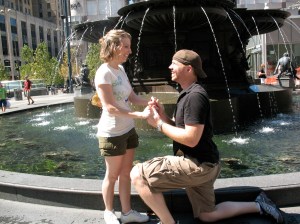
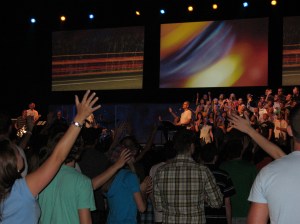
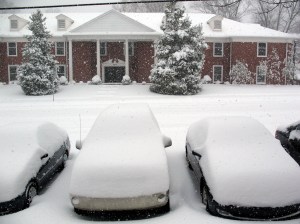
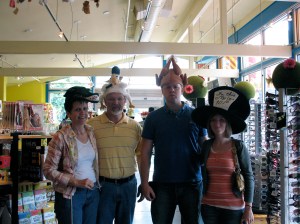
Here are some pictures from year three – a reenactment of our engagement in Cincinnati (2nd anniversay), Naak bowling, the LU guys and gals, New Attitude conference with my in-laws (now called “Next“), a big snow storm, and my parents trying on some hats at Lynn’s Paradise Cafe:


Reflections on Seminary part 2
The second year of seminary proved equally eventful. The first items on our list to complete once we moved to Louisville were to find a church and find a job! God was gracious in both. About two weeks into our transition to Louisville (with an apt. on Noblitt Drive – our own little ghetto hideaway!) I was hired at Kenwood Baptist Church as Pastor of Worship and Jenn was hired as an academic counselor for the University of Louisville. Indeed, God was very gracious. I additionally began to go to school full-time at SBTS, sitting under men like Drs. Russell Moore, Duane Garrett (now my Ph.D. supervisor) and Tom Nettles. I was learning Hebrew (a fruitful enterprise for anyone!), studying the Bible, leading worship, and struggling to be a good husband and diabetic. The latter was, and is, harder than the former, given that my excellent wife makes husbandry so much fun! Towards the end of that year I also was ordained by Kenwood, and then spent a couple of weeks hiking through the Grand Canyon with my great friend, Justin Petrochko (BFF, for sure…).
One of the great challenges during this year was disciplining myself to accommodate the seminary work load, particularly the reading. For those who are not familiar with the seminary lifestyle, reading is a fundamental requisite. And not just any reading. No, in seminary we don’t have the pleasure of reading great literary works from Dostoevsky, Dickens, or Bronte. Rather, we read books that take a few moments to figure out what even the title might mean. At seminary, the professors have a much different interpretation of Ecclesiastes 12:12 than Solomon probably did – “Of the making of many books there is no end.” For instance, this first semester I noticed in the syllabus a certain book for my class on John Calvin entitled, Protestant Scholasticism: Essays in Reassessment. Huh? (that was my first reaction). At that point in my life everything about that title gave me the sweats! I figured, then, I should dissect the title word-for-word. I knew what a “Protestant” was, but what the heck is “Scholasticism?” I knew what an “Essay” is, but what in the world is an “Essay in Reassessment?” Thus, I began my journey. But I quickly figured out that reading the work of John Calvin was fun (I read his magisterial Institutes of the Christian Religion my first semester), as well as reading theology. Henceforth I became a lover of books and reading!
But back to my original problem: what about disciplining oneself to accomplish all this reading? Each class required, on average, about 1200 pages of reading. I usually took 4 classes per semester, which amounts to nearly 5000 pages. My solution, and my recommendation, is threefold. First, try your best to get a list of the reading requirements for your semester as early as possible and begin to digest the material ahead of time. In a given semester, I would usually order my books at least a month in advance and have a couple of books completed by the start of the class. Believe me, this pays off in the end. Second, read at all times of the day. Know what periods of the day are better for you to focus and commit to them. Perhaps this is early in the morning (like me), or later in the evening (like most seminarians). But don’t be content to leave your reading to this period. When you have 15-30 minutes here or there for lunch or whatever, try to get some reading done. This could also be time in the car in the middle of a traffic jam, or while in the waiting room at the dentist’s office (who needs those magazines anyway?). Again, the payoff is great, even if you only get a few pages read here or there. Third, just focus. We have so many distractions around us that keep us from getting work done. I would suggest sacrificing any number of those distractions for good solid work. I am always amazed when I go to the school library and see someone sitting at a table with their laptop open, earphones in, iphone nearby, reading a book. What?! How can one expect to get anything done with all those distractions? Perhaps I’m just not a good multi-tasker, but if I’m required to read and absorb Justification and Variegated Nomism then I think it would be wise to set aside other things in order to concentrate on the subject matter. So that’s my recommendation/admonition. Read ahead of time, at all times of the day, and focus while doing so.
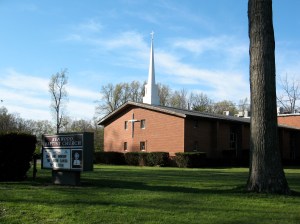
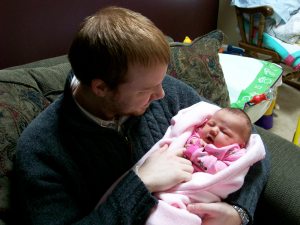
Here are few pictures from year two – the campus at SBTS, the Kenwood church building, a few Grand Canyon pics with Justin, and my little niece, Josie, who came into the world during this second year:





 Josh Philpot