Ardel Caneday on Peter Enns and the NT Use of the OT
At the Credo Magazine blog, NT scholar Ardel Caneday completed a series on the NT use of the OT, and particularly with recent arguments from OT scholar Peter Enns. Enns was dismissed from Westminster Theological Seminary a few years back (he may have resigned; I can’t remember) over the hermeneutical position he took in the book, Inspiration and Incarnation. The articles from Candeday are long but worth the time for anyone interested in the topic, especially the last two which deal with Enns in particular:
On the New Testament’s Use of the Old Testament (part 1)
On the New Testament’s Use of the Old Testament (part 2)
Would Paul Have Made a Good Evangelical? (part 3)
Would Paul Have Made a Good Evangelical? (part 4)
While not dismissing the value of some of Enns’ works on the OT (his Exodus commentary in the NIVAC series is excellent, as are some of his contributions to Wisdom Literature studies), his more recent works have only confirmed why WTS dismissed him (rightly, in my opinion) from their faculty.
The “Voice” of Moses in Deuteronomy
In his new collection of essays, The Gospel according to Moses: Theological and Ethical Reflections on the Book of Deuteronomy (Cascade, 2012), Dan Block has a helpful chart delineating the “voices” in Deuteronomy, which I’m providing below. The content comes from a previously published article, “Recovering the Voice of Moses: The Genesis of Deuteronomy,” JETS 44 (2001): 385-408. Based on internal and external evidence, Block argues that three particular voices are clear: (1) Yahweh’s voice, (2) Moses’ voice, and (3) the narrator’s voice.
- Yahweh’s Voice in Deuteronomy—31:14b, 16b-21, 23b; 32:49-52; 34:4b
- Moses’ Voice in Deuteronomy
- Moses’ Lone Voice—1:6-4:40; 4:44-26:19; 28:1-69 [Eng 29:1]; 27:11-26; 29:1 [Eng 2]-30:20; 32:1-43, 46b-47; 33:2-29
- Moses’ Accompanied Voice—27:1-8, 9-10
- The Narrator’s Voice in Deuteronomy—1:1-5; 2:10-12, 20-23; 3:9, 11, 13b-14; 4:41-43, 44-5:1a; 10:6-9; 27:1a, 9a, 11; 28:68 [Eng 29:1]; 29:1 [Eng 29:2]; 31:1-2a, 7a, 9-10a, 14a, 14c-16a, 22-23a, 24-25, 30; 32:44-46a, 48; 33:1-2a; 34:5-12
Block holds the traditional view that Moses is the author/speaker (the main “voice”) of the majority of the book of Deuteronomy, and I think his article is convincing on this point and helpful, especially as I read through the biblical book. Block has also published a companion volume prior to this one, How I Love Your Torah, O Lord!: Studies in the Book of Deuteronomy (Cascade, 2011). Both volumes are great to have in my personal library, and I look forward to his forthcoming commentary on Deuteronomy in the NIVAC series, which is slated to be released in August 2012.
Counterfeit Gospels—Trevin Wax
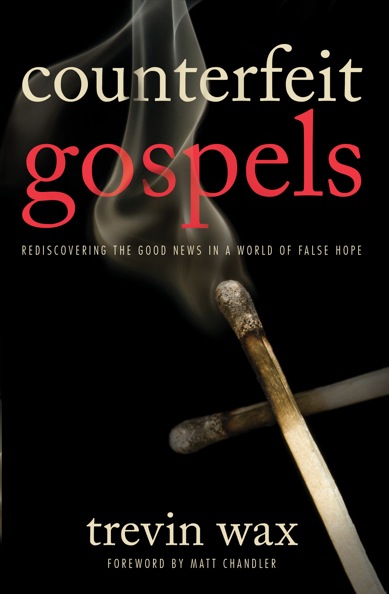 A couple of months ago I put my name into this site, and then I received a copy of this book from the publisher for the purpose of this short review. I was please to see that the book I received was by Trevin Wax, Counterfeit Gospels (Moody, 2011). I’ve always enjoyed Trevin’s blog, and I’ve had the opportunity to speak with him a couple of times. He’s a great guy and I’m thankful for the work he is doing for the church at Lifeway.
I was skeptical about Counterfeit Gospels at first, mainly because so many books on the gospel have been printed recently and I didn’t think that we needed another. But I really enjoyed this one in particular. Trevin’s writing style is engaging and personal. Many of his stories and illustrations I can relate to, which kept me reading. The book is broken up into three parts: (1) Story, (2) Announcement, and (3) Community. These three parts form the backbone of the biblical gospel. There is a story that culminates in Jesus (his life, death, and resurrection), an announcement that all people should repent and believe, and a community that gospel believers should be a part of—the church. Trevin frequently refers to this as a three-legged stool: the gospel story provides the context for the gospel announcement, which then births the gospel community. The best way to do evangelism, Trevin says, is to emphasize all three.
Within each part Trevin highlights two “counterfeits” that subvert the gospel. For part 1 there is the therapeutic and judgmentless gospels, each offering a counterfeit story/announcement/community. In part 2 Trevin mentions the moralistic and quietistic gospel counterfeits, and in part 3 the activist and churchless counterfeits. I won’t explain them here, but Trevin provides a helpful chart on pg. 210. All of the counterfeits are false gospels that ensnare the church. Thus the purpose of the book is to articulate the true gospel and to show how attempts to change it ultimately fall flat.
The implications of the gospel are far-reaching, so the church must get it right. Every generation will need to understand the biblical gospel and apply it to appropriate contexts. Trevin Wax has given us a great little aid for doing that in this generation, and I’m glad I had the opportunity to read Counterfeit Gospels and recommend it to others.
Unbroken—Laura Hillendbrand
 This is a fantastic book about Louie Zamperini, a WWII vet who survived a plane crash, 47 days adrift at sea in a life raft, and then nearly three years of hard labor and torture at the hands of the Japanese. He’s eventually rescued after the atom bomb ends the war. The story takes so many unexpected turns it’s almost unbelievable. And the best part is that after the war Zamperini comes to grips with his own sinfulness and despair and somehow finds his way to a Billy Graham crusade in Los Angeles. There he puts his faith in Christ and is forever changed.
When this book was released I kept avoiding it because I knew I would get sucked in and be distracted from seminary reading. But I’m glad that I finally read it. I would encourage anyone interested in WWII history to pick it up.
Journal for the Evangelical Study of the Old Testament
I’m excited to see the publication of the Journal for the Evangelical Study of the Old Testament, which is completely online and available to all. The first issue can be found here: http://jesot.org/issues/1-1-2012/
John Hobbins, who is on the editorial board, gives his assessment on his blog this morning, and his comments are intriguing. I would encourage anyone interested to check it out: Introducing JESOT
I read through Doug Stuart’s review of the new Exodus commentary by Victor Hamilton (Baker, 2011), which is illuminating to say the least. I hope to review this work through another journal, and I will give due attention to Stuart’s comments. In a gist, Stuart says that about 1/3 of Hamilton’s novel ideas are worth their salt. The rest are rubbish.
God’s Wisdom in Proverbs—Dan Phillips
 Intro: I read most major works on the book of Proverbs for my doctoral coursework. So I try to make myself aware of new material on Proverbs. Kress Biblical Resources recently released a new book by Dan Phillips entitled, God’s Wisdom in Proverbs. Phillips is a pastor and blogger (see here). I first heard of him via his contributions to the Pyromaniacs blog. His writing is engaging and often humorous. It’s unique in the sense that I almost get the feeling that I’m conversing with him as I read. There is a give-and-take feel that is enjoyable. This new book is no different in style, although it is particularly rich theologically and pastorally, which is a refreshing take on a book that many take to be full or moralistic maxims.
Summary: The main thrust of God’s Wisdom in Proverbs is that the biblical book is not primarily about wisdom in general, but wisdom rooted in the revelation of God’s word; i.e., a wisdom that is defined as the skill for living in the fear of Yahweh. The first two chapters deal with interpretative issues, authorship, and design. Then Phillips spends a great deal defining “the fear of Yahweh” and “wisdom” in both the context of Proverbs and God’s unfolding revelation. These early chapters are focused on the sections of Proverbs that are most familiar: 1:1-7, 2:1-5, and 3:1-12. Then Phillips has three lengthy chapters on big topics in Proverbs like godly relationships, marriage, and child-training. The book ends with four appendices that provide further material—FAQ’s, as it were—on common mistakes and questions that Proverbs addresses, as well as some suggestions for teaching or preaching from the book. As someone who has thought a lot about how best to preach from Proverbs, I found this section particularly helpful.
I was a little confused as I began reading this book because I was expecting something entirely different. The title suggests that the book is a commentary. It is not a commentary. It begins like one (with introductory topics on the front end) and ends like one (with appendices on a few ancillary issues). So my initial comments in the margins of the book are the critical “this-is-not-how-to-write-a-commentary” type. But as I continued to read I was corrected, and then I was more and more refreshed by Phillips’ writing, particularly in the chapters on marriage and child rearing. Indeed, I think Phillips has written the best thematic study on training children in Proverbs that I have read. No other commentary or book goes into the depth that he does on this topic, which includes a helpful biblical theological perspective. I was greatly encouraged by it and I hope to read that section again with my wife.
A little criticism: I have a few points of critical interaction. First, if someone is interested in delving into the issues surrounding Solomonic authorship I would suggest a few other resources. This is not to say that Phillips’ arguments are invalid, only that he doesn’t deal with all the historical and grammatical evidence against Solomonic authorship (I obviously agree that Solomon wrote the majority of the book). For instance, there is no mention of the Wisdom of Amenemope and how it relates to Proverbs 22:17-24:22, which is a huge issue in the authorship of Proverbs debate. One might think that this discussion has no place in a book like the one Phillips is writing, but since he devotes 11 pages at the beginning of the book to the issue of authorship in addition to an entire appendix (20 more pages), I would say that a big issue like this is worth treating (or at least referencing). He could easily point to Kenneth Kitchen’s article, “Proverbs and Wisdom Books in the Ancient Near East” (TB, 1977) or even Waltke’s section in his commentary to refute the critical view that says the Proverbs were adapted from Egyptian wisdom literature (which is patently false).
Second, the bibliography is a little dated, too, and Phillips missed a few excellent works like Steinmann’s commentary in the Concordia series (2009). That commentary has its own issues, but overall it’s the newest exhaustive commentary on Proverbs from a conservative perspective. Additionally I would have liked to see journal articles in the bibliography, of which there are very few. On the sources that Phillips does include in the bibliography, he adds a few comments so that readers know ahead of time what he thinks about the source. I’m studying with Duane Garrett who wrote a commentary on Proverbs (albeit a short one). On this book Phillips writes, “I would say that 90% of the time I go to Garrett for help with a verse, I come away disappointed.” I would be happy to expound on that point if Phillips ever desires to hear it. 🙂
Third, sometimes the organization of the various chapters is confusing. I would expect that in a book on Proverbs, for instance, the author to treat the material of a specific topic (such as marriage) within the book of Proverbs first before going to other books of the Bible to find material on the same topic. Phillips does this the other way around. In the end the reader arrives at the same point, just only by getting there via different avenues.
Last, Phillips goes a little overboard on word studies. I grant that lexical analysis is needed, especially in Proverbs as every commentator is prone to point out. But I think that Phillips could communicate his points clearly without going into the definitions of so many words. The definitions help, 0f course, but I was more interested in how the words are used in various contexts.
Conclusion: Dan Phillips and I are a like in a few ways. We’re both pastors. We’re both new to the Houston area. He’s bald and I’m balding. And we both love the book of Proverbs. On this last point I’m grateful that he has given us a fresh look at Proverbs with a pastoral perspective. He is a clever and witty writer, and the his points are clear. Although I have a few foibles with the book, it’s infinitely better than Longman’s How to Read Proverbs, and deserves a place on the shelf. I’m glad to have read it and I would certainly recommend it to others. It’s not a seminary-type book and I wouldn’t use it in the classroom at the M.Div. level, but I would in an undergrad setting.
Anecdote from D.A. Carson
I like getting glimpses of the personal lives of respected scholars like D.A. Carson. This is a humorous illustration he uses for describing the spiritually immature Christians in 1 Cor 3:1-4, from “The Cross and Christian Ministry“:
When my daughter was born, my wife found herself unable to nurse our infant. That gave me the privilege of sharing the midnight feedings. Tiffany was a dream: I could zap the formula in the microwave, change her, feed her the whole eight ounces, and tuck her back into her crib—all in under twenty minutes. Then our son came along. Midnight feedings with him were horrendous. Although he had an enormous appetite, he sucked and drank with only three speeds: slow, dead-slow, and stop. Worse, he had to be burped every ounce or so—a painfully slow process—or he would display his remarkable gift for projectile vomiting. Without any warning, he could upchuck what he had taken in and send it fiteen feet across the room. If there were an Olympic event in projectile vomiting, he would have taken one of the medals. I never got him back into his crib in under an hour; an hour and a half was more common.
Here is how he applies the illustration:
At least he had an excuse. He was young, and his digestive system was obviously not as well-developed as his sister’s at the same age. Best of all, he quickly outgrew this stage. But there are Christians who are international-class projectile vomiters, spiritual speaking, after years and years of life. They simply cannot digest what Paul calls “solid food.” You must give them milk, for they are not ready for anything more. And if you try to give them anything other than milk, they upchuck and make a mess of everyone and everything around them. At some point the number of years they have been Christians leads you to expect something like mature behavior from them, but they prove disappointing. They are infants still and display their wretched immaturity even in the way that they complain if you give them more than milk. Not for them solid knowledge of Scripture; not for them mature theological reflection; not for them growing and perceptive Christian thought. They want nothing more than another round of choruses and a “simple message”—something that won’t challenge them to think, to examine their lives, to make choices, and to grow in their knowledge and adoration of the living God (pg. 72).
Customize OSX
Simple Terminal commands are the easiest way to customize your desktop experience on a Mac. Every now and then I’ll look for new commands because I like to play around with the OS on my laptop and experiment with different looks or controls. A user over at Github recently posted the 65 best terminal commands in OSX Lion. I’ve already implemented a few: https://github.com/mathiasbynens/dotfiles/blob/master/.osx
New ESV/BHS Diglot from Crossway
Yesterday I received Crossway’s new ESV/BHS diglot Old Testament. It’s bigger and bulkier than I had hoped, and the pages are super thin so that I can see right through them to the text on the other side. But even so, I’m happy to have a diglot with the ESV text, which I prefer and which is the version that our pastor uses. Here are a few pics:
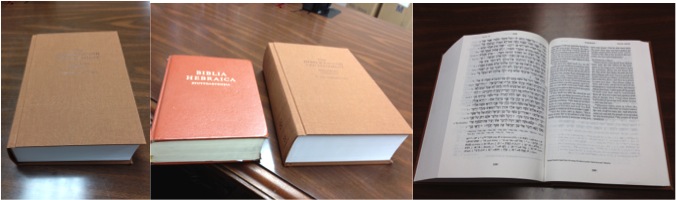
If you’re interested in other diglots of the OT I would suggest the JPS Tanak, the NKJV/Hebrew, or KJV/Hebrew, all published by the American Bible Society. I don’t know of others. I also have the NA27/NET Bible for the NT.
New Preaching Commentary by Jim Hamilton
 I first met Jim Hamilton three years ago in 2009 in an attempt to convince him to be the preaching pastor at my church, Kenwood Baptist. He was intrigued and agreed to come preach for two Sundays and pray about it. Which text did he preach on as a candidate for pastor? Revelation 9 for the first and Revelation 10 for the second. Although skeptical at first (I say that with a smile), I was blessed afterward.
When we called him as pastor a month later he preached through the entire book of Revelation in a little over a year. The sermons are outstanding and you can find them on Kenwood’s website here. He has preached through four more books since that time (Titus, Ezra, Nehemiah, Mark, and now Jeremiah), but the sermons on Revelation are favorites of mine.
The sermons are now in manuscript form and part of the Preaching the Word commentary series. Revelation: The Spirit Speaks to the Churches is Jim’s newest book, and I’m thankful for the copy I have in my hands. Jim sets Revelation in a biblical theological context, combining exegetical precision with pastoral sensitivity. I’m grateful for his efforts in this regard. Jim communicates in a way that sticks, so to speak. I never left the pew on Sunday without having grasped both the meaning of the text in context and the need to “do” and apply. Jim is unique in this way. After all, who else do you know who would preach on the Seven Angels and Seven Plagues (Rev 15) on Christmas!
I want to encourage readers to get a copy of this commentary, and you won’t be disappointed.

 Josh Philpot