Best Version of “Come Thou Fount of Every Blessing”
Robert Robinson’s hymn, “Come Thou Fount of Every Blessing,” is frequently sung in churches around the world each Sunday. This Sunday I again share the privilege of leading congregation worship with this hymn. What most Christians don’t know is that the version in their hymnals is abbreviated. My friend, Andrew Case, pointed me to the original 5-verse hymn in 2008, and I’ve been using it ever since. The lyrics are even more profound in the original, and the hymn just makes more sense. I’m posting this version below for good reference, which you can find on Wikipedia. In my opinion, the best recorded version I have ever heard of this song is by Andrew Case, which you can download at his website here. I enjoyed collaborating with Andrew on this recording, and you can hear me playing the piano in the background.
1. Come, Thou Fount of every blessing,
Tune my heart to sing Thy grace;
Streams of mercy, never ceasing,
Call for songs of loudest praise.
Teach me some melodious sonnet,
Sung by flaming tongues above.
Praise the mount, I’m fixed upon it,
Mount of Thy redeeming love.
2. Sorrowing I shall be in spirit,
Till released from flesh and sin,
Yet from what I do inherit,
Here Thy praises I’ll begin;
Here I raise my Ebenezer;
Here by Thy great help I’ve come;
And I hope, by Thy good pleasure,
Safely to arrive at home.
3. Jesus sought me when a stranger,
Wandering from the fold of God;
He, to rescue me from danger,
Interposed His precious blood;
How His kindness yet pursues me
Mortal tongue can never tell,
Clothed in flesh, till death shall loose me
I cannot proclaim it well.
4. O to grace how great a debtor
Daily I’m constrained to be!
Let Thy goodness, like a fetter,
Bind my wandering heart to Thee.
Prone to wander, Lord, I feel it,
Prone to leave the God I love;
Here’s my heart, O take and seal it,
Seal it for Thy courts above.
5. O that day when freed from sinning,
I shall see Thy lovely face;
Clothèd then in blood washed linen
How I’ll sing Thy sovereign grace;
Come, my Lord, no longer tarry,
Take my ransomed soul away;
Send thine angels now to carry
Me to realms of endless day.
Tip on How to Replace Hyphens with En Dashes in MS Word
Recently I was looking over a paper I had written for a seminary class which conformed to the SBTS Style Manual. This manual is unique to SBTS and is loosely based off of the Chicago Style Manuel (Turabian). But I wanted to submit this paper to a journal, and nearly every biblical studies journal requires SBL Style, also similar to Chicago style but much different from the SBTS style. One difference, for instance, is that SBL style requires en dashes between numerals (Gen 3:14–19) while SBTS style allows for simply hyphens between numbers (Gen 3:14-19). It’s a very small difference, but I guess editors are different people.
So who wants to go through an entire research paper and change all hyphens to en dashes?! I don’t, so after two minutes of googling I found this quick solution for those who use MS Word on a PC or Mac (I happily fall into the latter category):
- Go to “Edit” and click on “Find” or “Find and Replace” (or just Ctrl + “F” or Cmd + “F”)
- Click on the “Replace” tab
- In the “Find what” field type ([0-9])-([0-9])
- In the “Replace with” field type \1–\2 (notice the en dash in between, not a hyphen)
- Select “Use wildcards”
- Click “Replace All”

And there you have it. If you run this script all hyphens between numerals will be replaced with en dashes. If you have hyphens between words they will remain the same. Saved me a bunch of time. Might be helpful for others. Thanks to Phil Gons for the help.
Update to Zotero
If you’re like me and you’ve abandoned Firefox in favor of the much faster Chrome, and if you frequently log bibliographic data for papers and such, then you’ll be please to note that Zotero has updated its excellent software for use in almost any web browser. The software was previously a Firefox-only extension. Now you can use it as a stand-alone application, or continue to use it within a browser. Details are here.
And, it’s free.
If you’re not familiar with Zotero, you can read my overview here and here.
Numbers 16 in Psalm 55
Tonight I taught on Psalm 55 at Kenwood Baptist Church. The psalm is about David’s inner turmoil and anguish due to the betrayal of a close friend(s). Verse 15 stands apart in that David calls for harsh judgment on these former companions—”Let death steal over them; let them go down to Sheol alive.”
“Sheol” is found frequently in the Bible, but as I was studying the psalm I realized that the latter phrase of v. 15—”let them go down to Sheol alive”—is unique in that it appears only twice in the OT: here in Psalm 55:15 and also in Numbers 16:30, 33, the passage about the Korahite rebellion. In that passage, Dathan and Abiram are destroyed as a consequence of their rebellion against God and their rejection of Moses’ leadership. To demonstrate that God had judged their insolence and that their death was not the ordinary lot of human beings, the ground opened up and Dathan, Abiram, and their families “went down alive to Sheol.” The Hebrew construction in Numbers 16:30, 33 is essentially identical to the one in Psalm 55:15:
Num 16:30 — וְיָרְדוּ חַיִּים שְׁאֹלָה
Ps 55:15 — יֵרְדוּ שְׁאוֹל חַיִּים
So perhaps David had the Korahite rebellion in mind when he called for judgment on his enemies/former-friends. What he wants is probably not the same mode of judgment (i.e. the ground opening up), but the same kind of judgment—abrupt and unexpected.
Customize Your Mac Desktop
Whenever I get a new computer I spend some time customizing the desktop to fit my needs and preferences. So when I recently got a new Mac for my office (thank you UofL), I added some additional features and changed a few icons. All of this is very easy to do. If you like the way mine looks I’ve provided instructions below:

Since I have the date and time on the desktop I don’t need them in the Mac menu bar, usually on the top right. These two features are live and operated by a program called Geek Tool, which is a free app in the Mac App store and which is easy to use. Mine is in Helvetica font.
The desktop image can be found here.
Instructions for setup can be found here.
I found the .Mail, Chrome, and Safari icons by doing a simple image search on Google. I personally hate the default icons for these apps, and these are more appealing to me.
In my dock I also have the Reeder app, which has a great interface for reading blogs from your Google Reader. I’ve been using it for a long time and have no complaints. I also have Accordance software for Bible study and 1Password for managing the 50+ passwords I have online.
Enjoy!
A few thoughts on Exodus 34:29
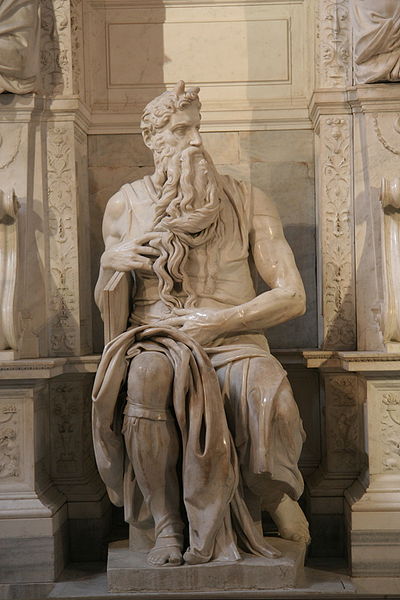
- Moses’ second descent from Sinai is much different from the first. This time he has two new tablets and a changed complexion: the skin of his face is “shining” (from Heb. qrn) because he had been talking with God. The use of qrn here is odd since it usually means “horns,” not “to shine,” as depicted in Michelangelo’s statue of Moses in the church of San Pietro, Rome. Michelangelo based his depiction of Moses on the translation of qrn in the Vulgate (“he knew not that his face was horned“).
- Scholars differ on the interpretation of qrn in Exod 34: Jirku (“horns”), Propp (“disfigurement,” or blistered skin), Sasson (“horns”), Stuart (“rays”), Sanders (“light”), Cassuto (“rays of light”), Childs (“rays of light”), Enns (“afterglow”), etc. The LXX has, “the skin of [Moses’] face had become glorified.” Paul follows the LXX: “The Israelites could not look steadily at the face of Moses because of its glory” (2 Cor 3:7).
- While it is true that qrn normally means “horns” (see HALOT, vol 3, 1144), in this case we must consider alternatives. The verbal form here in Exod 34 literally means “to show horns,” not “to shine.” But consider this analogy: my kids and I drew a picture of the sun today with yellow crayons. Like most kids do (and adults too), we drew spikes, or “horns,” around the sun to show that it emanates light and that it’s really hot. Perhaps what we have in Exod 34 is similar. The skin of Moses’ face shines just like the sun shines. Instead of saying that Moses’ face “was shining” (using the normal language of illumination) the author of Moses depicts Moses’ face much like we would draw the sun: he had horns of light (a similar analogy would be the head of the Statue of Liberty); that is, rays that reflect the very brightness of Yahweh’s own presence. As Cassuto writes, “Something of the divine glory remained with [Moses], and on an infinitesimal scale he also had rays at his side—enveloping his countenance.”
- Habbakuk 3:4 substantiates the interpretation of qrn as rays of light: “[God’s] brightness was like the light; beams of light (qrn) come from his hand; and there he veiled his power.”
New Titles from Peter Enns


I noticed today that Peter Enns has two new books that will be available later this year: a commentary on Ecclesiastes (NHC) and another entitled The Evolution of Adam. He gives a description of each in this post, and both will be intriguing to say the least. I think it interesting that he says the following in his description of the Ecclesiastes commentary:
Those of you who know me well will not be surprised that in the theological section I apply a Christotelic hermeneutic. Also, for the truly geekified among you, I do not see Qohelet’s words as corrected by the epilogue but affirmed as wise–though not the final word. I also see Qohelet as a suffering Christ figure. (Yes, you heard me right.)
Having read Enns’ Exodus commentary in its entirety (in the NIVAC series), I can vouch for Enns’ exegetical skill. That commentary is superb, and so I look forward to good things from this one too. Enns is well-versed in the Wisdom writings and the secondary literature. Interested students should pick up his annotated bibliography, Poetry and Wisdom (Baker), which I found really helpful last year during my independent study on Proverbs with Duane Garrett.
On The Evolution of Adam, Enns says it “applies the approach of Inspiration and Incarnation to a specific and pressing issue: in view of evolution, what does it mean to read the Bible well? So think of EOA as I&I part two.” Having also read I&I (and having significant disagreements), this new work will no doubt receive attention from evangelicals, especially given the events surrounding I&I at Westminster Seminary and the ensuing debate that lead to Enns’ departure.
Eisenbrauns Deal of the Day!
Eisenbrauns has Biblia Sacra for its deal of the day. It’s half off for those interested!

Biblia Sacra Utriusque Testamenti
Editio Hebraica et Graeca
The Nestle-Aland 27th edition and BHS small edition bound together
Deutsche Bibelgesellschaft Stuttgart, 1994
93 + 810 pages (Greek) + lvii + 1574 pages (Hebrew), Greek and Hebrew
Cloth
ISBN: 9783438052506
List Price: $139.99
Your Price: $70.00
www.eisenbrauns.com/item/BIBLIASAC
Charles Halton on Authors or Criminals
Charles Halton has recently penned an interesting blog on authorship, plagiarism and authority. Then John Meade and Jim Hamilton added some critical comments, and the ensuing discussion is worth a look.
Adoption Video for Crossway
In March of this year the Adopting for Life conference was in Louisville, KY. A friend of ours asked if we would like to be interviewed by Crossway (who published Russell Moore’s book, “Adopted for Life“) about our upcoming adoption. The interview is now on Vimeo here, and will be on the Crossway blog sometime soon (we’re not really sure when).
At the time when this video was shot we were one week away from picking up our two kids from Ethiopia. I think you can see how excited we were, and how pretty my wife is . . .

 Josh Philpot